
Menu
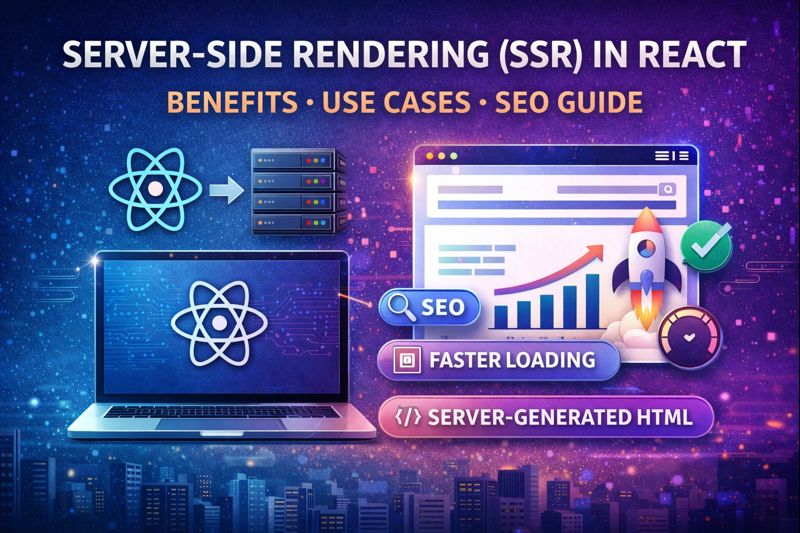
A Complete Guide for Faster, SEO-Friendly Web Applications
In modern web development, performance and search engine visibility are critical success factors. While React is known for building powerful client-side applications, Server-Side Rendering (SSR) has become increasingly important for improving load speed, SEO, and user experience.
This article explains what SSR is, how it works in React, its benefits, limitations, and when businesses should use it.
What Is Server-Side Rendering (SSR)?
Server-Side Rendering is a technique where a React application is rendered on the server instead of the browser. The server generates the fully rendered HTML for a page and sends it to the client, allowing users to see content immediately.
After the initial page load, React takes over on the client side through a process called hydration, enabling full interactivity.
How SSR Works in React
The SSR process typically follows these steps:
- User requests a page from the browser
- Server renders the React components into HTML
- Server sends the HTML to the browser
- Browser displays the content instantly
- React hydrates the page and attaches event listeners
This approach combines the benefits of fast initial loading with rich client-side interactivity.
Why SSR Matters in Modern React Applications
1. Improved SEO
Search engines can easily crawl and index fully rendered HTML pages. This is especially important for:
- Blogs
- E-commerce websites
- Marketing and landing pages
- Content-heavy platforms
SSR significantly improves visibility in search engine results.
2. Faster Initial Page Load
Users see content faster because the browser does not wait for JavaScript execution to render the page. This leads to:
- Better user experience
- Lower bounce rates
- Higher engagement and conversions
3. Better Performance on Low-End Devices
SSR reduces the processing load on the client device, making applications more accessible to users with slower networks or older devices.
4. Enhanced Social Media Sharing
Platforms like Facebook and LinkedIn rely on page metadata. SSR ensures:
- Correct Open Graph tags
- Accurate previews when sharing links
SSR in React: Common Approaches
1. Using Next.js (Recommended)
Next.js is the most popular React framework for SSR.
Key features:
- Built-in SSR and SSG support
- File-based routing
- Automatic code splitting
- SEO-friendly by default
export async function getServerSideProps() { return { props: { data: "Server rendered content" } } }
2. Custom SSR with React and Node.js
React provides APIs like renderToString() for manual SSR setups.
Challenges:
- Complex configuration
- Higher maintenance cost
- More room for errors
This approach is typically used only for highly customized solutions.
SSR vs Client-Side Rendering (CSR)
| Aspect | SSR | CSR |
|---|---|---|
| Initial Load | Faster | Slower |
| SEO | Excellent | Limited |
| Server Load | Higher | Lower |
| Interactivity | After hydration | Immediate |
| Complexity | Medium–High | Low |
When Should You Use SSR?
SSR is ideal when:
- SEO is a priority
- Pages depend on dynamic, real-time data
- First Contentful Paint (FCP) matters
- You are building marketing or content platforms
CSR may be sufficient for:
- Internal dashboards
- Admin panels
- Highly interactive tools behind login
Challenges and Limitations of SSR
Despite its benefits, SSR has some trade-offs:
- Increased server costs
- More complex architecture
- Slower navigation if not optimized
- Hydration mismatches if code is not consistent
Proper caching, CDN usage, and hybrid rendering strategies can mitigate these issues.
SSR, SSG, and Hybrid Rendering
Modern React frameworks support multiple rendering strategies:
- SSR – Render on every request
- SSG (Static Site Generation) – Build pages at compile time
- ISR (Incremental Static Regeneration) – Update static pages dynamically
Using the right strategy for the right page is the best practice in 2026-ready applications.
Final Thoughts
Server-Side Rendering in React bridges the gap between performance, SEO, and rich user experiences. While it introduces additional complexity, frameworks like Next.js make SSR accessible and scalable for modern applications.
For businesses aiming to improve search rankings, page speed, and user trust, SSR is no longer optional—it is a competitive advantage.
A fast, SEO-ready website starts with the right rendering strategy.